Case study · 2026 · Commercial insurance

How a commercial broker compressed 3-day submission triage to 30 seconds

An AI-powered broker platform replaced manual ACORD reading with field extraction at 94% confidence — and gave the operation a live pipeline, carrier hit ratios, and risk scoring across fifty-plus factors.

  • ClientUS commercial insurance broker
  • IndustryCommercial P&C
  • Year2026
  • Engagement14-week build · ongoing operation
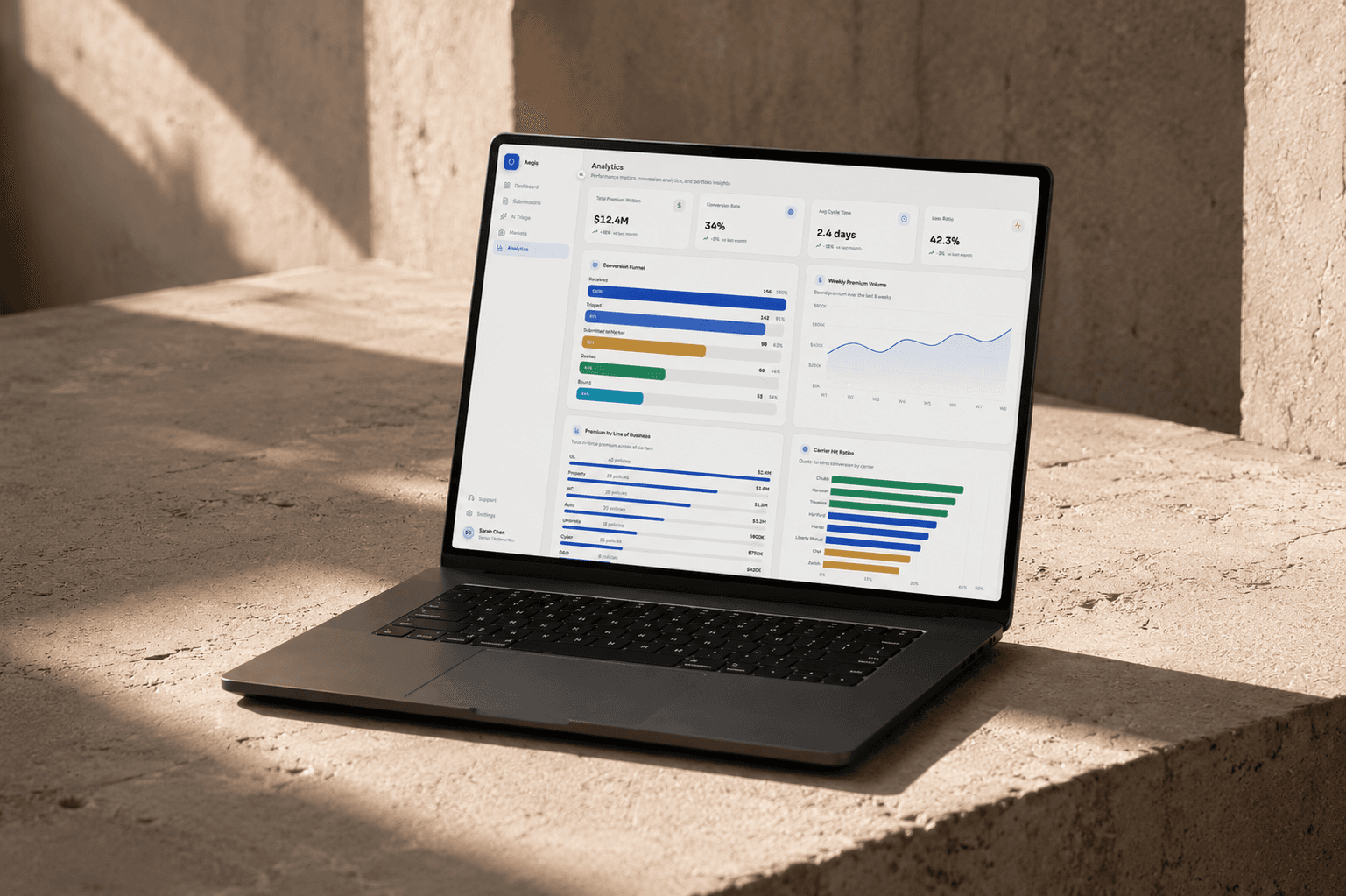
Aegis broker platform — a MacBook on a sunlit clay surface showing the live analytics dashboard with active submissions, average quote time, bind rate, and pipeline value.
01 — At a glance
30s
Median triage timeDown from 3–4 days of manual PDF reading.
94%
Field extraction confidencePer-field, surfaced in the UI — not a black box.
50+
Risk factors scoredPer submission, with explainable component scores.
Summary

Commercial insurance brokers run on PDFs and email. Every new submission arrives as a dense ACORD form, and a junior broker spends 3–4 days reading it, retyping fields into a spreadsheet, and chasing carriers one by one. We built an end-to-end broker platform — AI triage, submissions pipeline, carrier markets, analytics — that compresses that work to 30 seconds per submission and gives the team a live operational view of the whole book.

The problem

Procurement was held together with Excel and goodwill.

Commercial insurance does not run on software. It runs on PDFs and inbox threads. Every submission arrives as a fourteen-page ACORD application — insured name, NAICS code, revenue by segment, employee counts per location, prior loss runs going back five years, named-perils exposure, schedules of vehicles and properties. A junior broker opens the PDF, opens a spreadsheet next to it, and starts retyping.

Then the broker writes eight or twelve carrier emails, each one slightly different because each carrier wants the data in a different shape. Carriers reply over the next two to seven days — some quote, some decline with one-line reasons, some come back asking for a field the broker missed. A 3-to-4-day cycle, multiplied by dozens of active submissions per broker, multiplied by a team of fifteen.

Half our workweek was someone retyping numbers from a PDF into a spreadsheet — and we still had to chase fields they missed.

The compounding failures: transposed numbers in re-typing. Misread NAICS codes producing wrong appetite matches. Carriers rejecting submissions because one field was missing — wasted days. Bind rates dropping on time-sensitive lines because the broker quoted too slow. And junior brokers — licensed, expensive professionals — spending half their workweek doing data entry that a 1995 OCR vendor could in theory have automated.

The director of operations had been writing the RFP in her head for two years. She knew exactly what she needed. The market had nothing that fit.
Aegis dashboard — live KPI strip (Active Submissions, Avg Quote Time, Bind Rate, Pipeline Value, AI Triaged), submissions activity chart, AI Insights panel (hurricane exposure, cross-sell, carrier capacity), recent submissions list, and activity feed.

One operational view replaced the spreadsheet. KPIs update live, AI flags portfolio exposure, and every recent submission is one click from full detail.

02 — Why us

Why they chose Synara

Most "insurtech" tooling is built for the carrier side — Duck Creek, Guidewire, the policy-admin giants. The broker side, the team actually triaging incoming submissions, has no purpose-built workflow software. The closest things on the market were thin GPT chatbots glued on top of CRMs, which lacked the field-by-field explainability a licensed broker needs to defend their work.

The brief was specific: AI-driven extraction grafted onto a real broker workflow, with confidence scores surfaced in the UI on every field. No black-box decisions. A broker has to be able to look at any AI output, see why the model scored it the way it did, override the field with one click, and have the audit log record both the original and the override. We took the brief literally — every AI output in the platform is a transparent, explainable, overridable artifact.

03 — What we built

A three-portal procurement platform — buyer, supplier, admin.

Aegis broker platform — analytics dashboard rendered on a MacBook on a warm clay surface, showing pipeline KPIs and AI insights.
01

AI document triage

Drop an ACORD PDF on the upload zone. Insured name, industry, revenue, employee counts, locations, prior losses extract in under 30 seconds, each field stamped with its confidence score. Brokers see exactly which fields to verify and which to trust.

02

Risk scoring across 50+ factors

Industry hazard, prior loss frequency, exposure concentration, coastal and wildfire geography, employee density, premium-to-revenue ratios. Each component scored separately and rolled into a portfolio risk score with the math visible.

03

Full submission pipeline

New → Triage → Quoting → Quoted → Bound. Filter by line of business, risk band, premium, carrier, age. Click any submission for documents, extracted fields, incoming quotes, and a complete activity timeline.

04

Carrier hit ratios

Live tracking of which carriers quote, which carriers bind, average response time per line of business. Stops the team from wasting submissions on dead-weight markets and surfaces which appetite matches actually convert.

05

AI insights panel

The platform watches the portfolio continuously — flagging hurricane-season exposure in coastal accounts, surfacing cross-sell opportunities by industry segment, alerting brokers when a key carrier's capacity shifts.

06

Activity log per submission

Every email, every quote, every state change, every AI override is recorded with timestamp, actor, and old → new diff. E&O-grade audit trail without anyone having to maintain it manually.

04 — Architecture

In plain English, why each choice.

Frontend
Next.js 16 + React 19 with the App Router and server components by default. Tailwind 4 + shadcn/ui for the design system. Recharts for the analytics surfaces. Streaming UI for the triage flow so brokers watch fields appear in real time as the model extracts them.
AI layer
Anthropic Claude Sonnet 4.6 with structured-output JSON schemas. PDF parsing through pdf-parse with layout preservation, then field-level extraction with per-field confidence calibration. Risk scoring runs server-side on a feature pipeline; component scores returned as a transparent breakdown.
Data layer
Postgres with Drizzle ORM. Submissions, documents, carriers, quotes, activities, organizations, users, AI extractions, AI insights. Activity log is append-only and queryable by entity, actor, or date range.
Auth + multi-tenancy
Org-scoped routes with role-aware UI (broker / underwriter / admin). Server-side authorization checks on every endpoint. Tenants are isolated at the data layer; no cross-org read is possible by construction.
Realtime
Server-Sent Events for streaming triage progress and field-by-field reveals. The KPI counters on the dashboard pull live data and update without page reloads.
Integrations
Inbound and outbound email connectors per carrier, ACORD form templates, document storage on object-store with signed URLs. Built so adding a new carrier integration is config, not code.
05 — Outcomes

What changed after launch.

30s
Triage timeMedian submission triage — down from 3–4 days of manual work.
94%
Extraction confidenceAverage per-field confidence across ACORD applications.
↓ 18%
Carrier round-tripsFewer "missing field" rejections after switch to AI extraction.
↑ 12pp
Bind rate upliftFaster turnaround on time-sensitive lines moved the bind rate.

MethodologyNumbers are based on the client's internal submission logs. Pre-launch baseline is the manual workflow from the prior quarter; post-launch numbers are platform data from the first 90 days of operation. Median values where applicable. The bind rate uplift is calculated only on submissions where turnaround time previously sat above the carrier's quoting SLA — i.e., where speed was the binding constraint.

Aegis turned my submission triage team from data-entry into actual underwriting partners. We are closing faster, and our junior brokers are finally doing work that requires their licenses — not their typing speed.

Director of OperationsCommercial insurance brokerage
06 — What’s next

Direct API integrations with the major carriers (Travelers, Chubb, AIG) so submissions route end-to-end without email round-trips. Predictive bind scoring — probability of bind per carrier per submission, ranked at intake. A mobile companion for brokers in the field.

Stack
  • Next.js 16
  • React 19
  • Tailwind 4
  • shadcn/ui
  • Recharts
  • Anthropic Claude
  • pdf-parse
  • Postgres
  • Drizzle ORM
  • Server-Sent Events
  • Vercel

Have a workflow your team can't afford to keep manual?

Aegis was built for one brokerage. The pattern works for any submission-driven workflow — insurance, mortgage, procurement, legal intake. If your team is spending days on what should take seconds, let's scope it.

Start a conversation